

Join us for the next nTIDE Lunch & Learn Webinar featuring guest presenters Vicki Phillips, Mental Health Association Atlantic County, and Donald Campbell, Atlantic Center for Independent Living.
More People with Disabilities Are Seeking Work nTIDE June 2026 Jobs Report
Durham, NH – June 5, 2026 – The June 2026 National Trends in Disability Employment (nTIDE) report reveals a large increase in job seeking among people with disabilities, signaling that more individuals are entering the labor force as economic pressure intensifies. This finding aligns with last month’s nTIDE forecast that rising prices would push more people with disabilities to seek employment, while progress in employment access continues.
Issued monthly by Kessler Foundation and the University of New Hampshire’s Institute on Disability, nTIDE tracks how broader economic conditions affect employment trends for people with and without disabilities.
Based on data from today’s BLS Jobs Report and separate nTIDE analysis, the employment-to-population ratio for people with disabilities (ages 16-64) decreased slightly from 37.9 percent in April 2026 to 37.8 percent in May 2026 (down 0.3 percent or 0.1 percentage points). For people without disabilities (ages 16-64), the employment-to-population ratio increased from 74.9 percent in April 2026 to 75.0 percent in May 2026 (up 0.1 percent or 0.1 percentage points). The employment-to-population ratio, a key indicator, is the percentage of people who are working relative to the total population (the number of people working divided by the total population, then multiplied by 100).
Month-to-Month nTIDE Numbers (comparing April 2026 to May 2026)
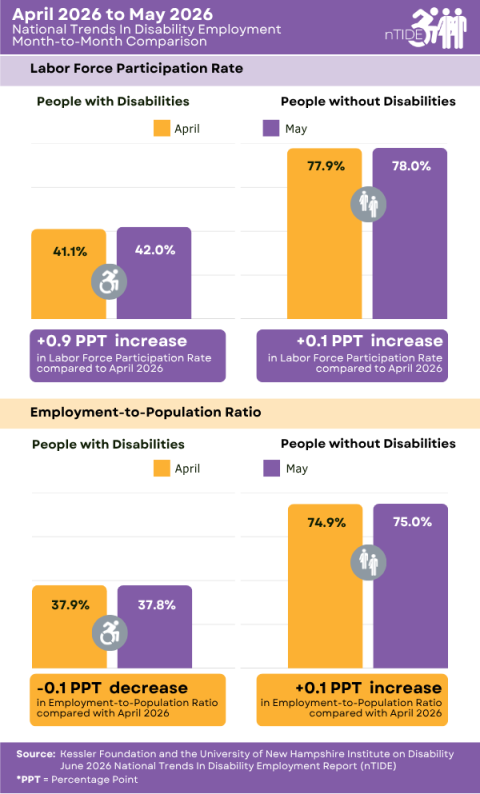
From April 2026 to May 2026, the employment-to-population ratio decreased from 37.9 to 37.8 percent for people with disabilities and increased from 74.9 to 75.0 percent for people without disabilities. The labor force participation rate increased from 41.1 to 42.0 percent for people with disabilities and increased from 77.9 to 78.0 percent for people without disabilities.
In contrast, the labor force participation rate for people with disabilities increased from 41.1 percent in April 2026 to 42.0 percent in May 2026 (up 2.2 percent or 0.9 percentage points). For people without disabilities, the labor force participation rate increased from 77.9 percent in April 2026 to 78.0 percent in May 2026 (up 0.1 percent or 0.1 percentage points). The labor force participation rate reflects the percentage of people who are in the labor force (working, on temporary layoff, on furlough, or actively looking for work in the last four weeks) relative to the total population (the number of people in the labor force divided by the number of people in the total population multiplied by 100).
“The labor force participation rate increased substantially while the employment-to-population ratio decreased slightly for people with disabilities. Taken together, these data suggest that more people with disabilities are entering the labor force and actively looking for work,” said Andrew Houtenville, PhD, professor of economics and director of the UNH-IOD. “This pattern is consistent with what we expect during inflationary periods, when people seek work to help offset rising prices and cover basic needs for themselves and their families. According to the most recent Annual Report on People with Disabilities in America, people with disabilities are more than twice as likely to live in families with incomes below the poverty line, making higher costs even more perilous for these households.”
Year-to-Year nTIDE Numbers (comparing May 2025 to May 2026)
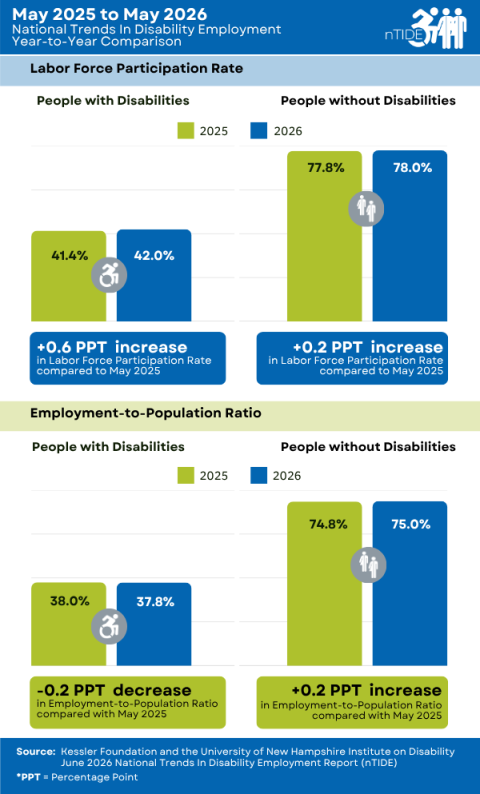
From May 2025 to May 2026, the employment-to-population ratio decreased from 38.0 to 37.8 percent for people with disabilities and increased from 74.8 to 75.0 percent for people without disabilities. The labor force participation rate increased from 41.4 to 42.0 percent for people with disabilities and increased from 77.8 to 78.0 percent for people without disabilities.
Compared with the same time last year, the employment-to-population ratio for people with disabilities decreased from 38.0 percent in May 2025 to 37.8 percent in May 2026 (down 0.5 percent or 0.2 percentage points). For people without disabilities, the employment-to-population ratio increased from 74.8 percent in May 2025 to 75.0 percent in May 2026 (up 0.3 percent or 0.2 percentage points).
The labor force participation rate for people with disabilities (ages 16-64) increased from 41.4 percent in May 2025 to 42.0 percent in May 2026 (up 1.4 percent or 0.6 percentage points). For people without disabilities (ages 16-64), the labor force participation rate also increased from 77.8 percent in May 2025 to 78.0 percent in May 2026 (up 0.3 percent or 0.2 percentage points).
In May, among workers ages 16-64, the 6,484,000 workers with disabilities represented 4.3 percent of the total 151,316,000 workers in the U.S.
Ask Questions about Disability and Employment
On the same day nTIDE is issued, the team hosts an nTIDE Lunch and Learn webinar. This live Zoom broadcast gives attendees a chance to ask questions about the latest findings, hear news and updates from the field, and learn from invited panelists who discuss current disability-related research and events.
On June 5, 2026, guest presenters Vicki Phillips, Mental Health Association in Atlantic County, and Donald Campbell, Atlantic Center for Independent Living, Principal at Unlock Access, joins Dr. Houtenville, and Shoshana Marin, Policy Fellow at the Association of University Centers on Disabilities. Visit the nTIDE archives at ResearchonDisability.org/nTIDE to see a recording of this nTIDE Lunch and Learn episode.
About National Trends in Disability Employment (nTIDE)
nTIDE is a joint effort of Kessler Foundation and the University of New Hampshire’s Institute on Disability. The nTIDE team tracks employment trends for people with and without disabilities, issuing monthly reports that reflect the impact of economic changes on the workforce. These reports use data from the U.S. Bureau of Labor Statistics but are customized by UNH-IOD to focus on working-age adults (ages 16 to 64). nTIDE is funded by the National Institute on Disability, Independent Living and Rehabilitation Research (NIDILRR; 90RTGE0005) and Kessler Foundation.