

Join us for the next nTIDE Lunch & Learn Webinar featuring guest presenters Jillian Curwin and Madison Lawson -
Q&A with disabled writers, podcasters, and creators, moderated by Lillie Heigl, AUCD. This is the first of three hour-and-a-half Special Sessions this year, which will offer a more in-depth discussion of the topic.
nTIDE: Employment of People with Disabilities Declines but Remains Near All-Time High
National Trends in Disability Employment February 2026 Jobs Report
Durham, NH – February 12, 2026 – The February 2026 National Trends in Disability Employment (nTIDE) report shows that employment of working-aged people with disabilities declined in January but remains near all-time highs set at the end of 2025. nTIDE is issued monthly by Kessler Foundation and the University of New Hampshire’s Institute on Disability. Due to the recent brief government shutdown, statistics for the month of December were posted yesterday and not the typical first Friday of the month. In November and December of 2025, both the employment-to-population ratio and the labor force participation rate moved well above the plateau that was established after the conclusion of the COVID-19 pandemic. In January, these indicators moved back toward the upper end of that post-pandemic plateau.
Based on data from today’s BLS Jobs Report and separate nTIDE analysis, the employment-to-population ratio for people with disabilities (ages 16-64) decreased from 38.9 percent in December 2025 to 38.4 percent in January 2026 (down 1.3 percent or 0.5 percentage points). For people without disabilities (ages 16-64), the employment-to-population ratio decreased from 74.8 percent in December 2025 to 74.5 percent in January 2026 (down 0.4 percent, or 0.3 percentage points). The employment-to-population ratio, a key indicator, reflects the percentage of people who are working relative to the total population (the number of people working divided by the number of people in the total population multiplied by 100).
Month-to-Month nTIDE Numbers (comparing December 2025 to January 2026)
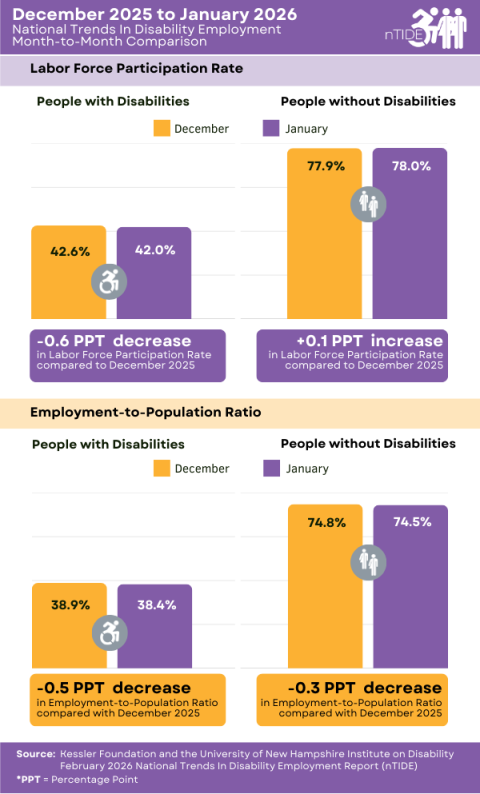
From December 2025 to January 2026, the employment-to-population ratio decreased from 38.9 to 38.4 percent for people with disabilities and decreased from 74.8 to 74.5 percent for people without disabilities. The labor force participation rate decreased from 42.6 to 42 percent for people with disabilities and increased from 77.9 to 78 percent for people without disabilities.
“Employment-to-population ratios in January (38.4%) were at similar all-time highs in November (39.8%) and December (38.9%), and remained higher than most numbers observed during the post-pandemic period,” remarked John O’Neill, PhD, director of the Center for Employment and Disability Research at Kessler Foundation. “If these numbers continue to increase, it suggests that people with disabilities are really striving to work and moving beyond the plateau that followed the COVID-19 pandemic.”
Similarly, the labor force participation rate for people with disabilities (ages 16-64) decreased from 42.6 percent in December 2025 to 42.0 percent in January 2026 (down 1.4 percent or 0.6 percentage points). For people without disabilities (ages 16-64), the labor force participation rate increased from 77.9 percent in December 2026 to 78.0 percent in January 2026 (up 0.1 percentage point). The labor force participation rate reflects the percentage of people who are in the labor force (working, on temporary layoff, on furlough, or actively looking for work in the last four weeks) relative to the total population (the number of people in the labor force divided by the number of people in the total population multiplied by 100).
“The labor force participation rate followed a similar pattern to the employment-to-population ratio, reverting back towards its post-COVID plateau,” said Andrew Houtenville, PhD, professor of economics and director of the UNH-IOD. “The next few months will be telling. Will these indicators revert further into the post-COVID plateaus, or will they increase to start new plateaus?” he added.
Compared with the same month last year, the employment-to-population ratio for people with disabilities (ages 16-64) increased from 38.3 percent in January 2025 to 38.4 percent in January 2026 (up 0.1 percentage point). For people without disabilities (ages 16-64), the employment-to-population ratio also increased from 74.4 percent in January 2025 to 74.5 percent in January 2026 (up 0.1 percent, or 0.1 percentage points).
Year-to-Year nTIDE Numbers (comparing January 2025 to January 2026)
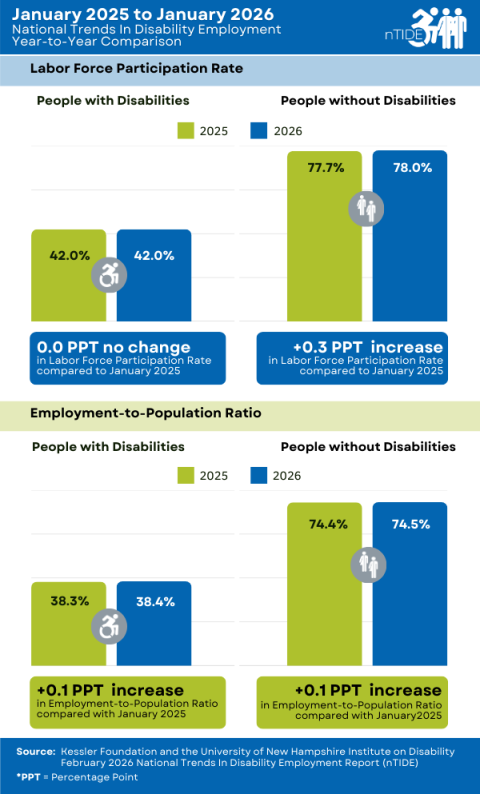
From January 2025 to January 2026, the employment-to-population ratio increased from 38.3 to 38.4 percent for people with disabilities and increased from 74.4 to 74.5 percent for people without disabilities. The labor force participation rate remained the same at 42.0 percent for people with disabilities and increased from 77.7 to 78.0 percent for people without disabilities.
The labor force participation rate for people with disabilities (ages 16-64) remained the same at 42.0 percent from January 2025 to January 2026. For people without disabilities (ages 16-64), the labor force participation rate also increased from 77.7 percent in January 2025 to 78 percent in January 2026 (up 0.4 percent, or 0.3 percentage points).
In January, among workers ages 16-64, the 6,903,000 workers with disabilities represented 4.6 percent of the total 151,586,000 workers in the U.S.
Ask Questions about Disability and Employment
On the same day nTIDE is issued, the team hosts an nTIDE Lunch & Learn webinar. This live Zoom broadcast gives attendees a chance to ask questions about the latest findings, hear news and updates from the field, and learn from invited panelists who discuss current disability-related research and events.
On February 12, 2026 guest presenters Jillian Curwin and Madison Lawson, disability rights advocates, join O’Neill and Houtenville, and Lillie Heigl, director of policy at the Association of University Centers on Disabilities. Visit the nTIDE archives at ResearchonDisability.org/nTIDE to see a recording of this nTIDE Lunch & Learn episode.
About National Trends in Disability Employment (nTIDE)
nTIDE is a joint effort of Kessler Foundation and the University of New Hampshire’s Institute on Disability. The nTIDE team tracks employment trends for people with and without disabilities, issuing monthly reports that reflect the impact of economic changes on the workforce. These reports use data from the U.S. Bureau of Labor Statistics but are customized by UNH-IOD to focus on working-age adults (ages 16 to 64). nTIDE is funded by the National Institute on Disability, Independent Living and Rehabilitation Research (NIDILRR; 90RTGE0005) and Kessler Foundation.